Stock Avoidance Syndrome: Positive for Disciplined Individual Investors

100% in Equities?

In February 2012 one of the very few Wall Street executives whose stature actually increased during the financial crisis, Blackrock CEO Larry Fink, told Bloomberg why he liked stocks:

“I have been pretty consistent on this since last August.  I would be 100% in equities.   I think Chairman Bernanke is telling you I am going to keep bonds down so low you can’t make a return that’s going to meet your needs owning bonds.  It is not that bonds are bad.  Bonds are priced so high that the return on bonds is just so minimal.  I don’t have a view the world is going to fall apart.  You need to take on more risk, you have to overcome all this noise, and there are great values in equities.  Equities are at a 20 or 30 year low in valuation.  When you look at dividend returns on equities versus bond yields, to me it is a pretty easy decision to be heavily in equities.”

Scared Stockless

We agree with Larry and would add that, in addition to attractive valuations, stocks’ fundamentals have rarely been better.  Companies are efficient, shareholder friendly, and uncommonly disciplined in their use of capital.  Nevertheless we expect the Stock Avoidance Syndrome to continue.  Investors have been so traumatized by recent bear markets, ongoing turmoil in Washington, and Federal Reserve over-reach that they are not going to quickly rotate from bonds into stocks.  Over the past three years investors pulled $291 billion out of equity funds and invested $476 billion in bond funds.  In the past two years there were only five months with positive flows into stock funds and two months with negative flows out of bond funds.

This is not a case of Main Street ignoring the sage advice of Wall Street.  Unlike Mr. Fink, Street strategists are still sufficiently risk averse that they are willing to accept the “minimal” returns available in the bond market.  Goldman Sachs is telling clients of its private bank to have 54.5% of their money in bonds, just 25% in stocks, and 20.5% in a range of “alternative investments” including hedge funds, private equity, and real estate.  Another major wealth management company is similarly cautious on stocks, recommending that wealthy individuals put 44% in stocks, 37% in bonds, 17% in alternative investments, and 2% in cash.

Alternative Alternatives

Aside from risk aversion, a second reason why investors are not following Larry Fink toward “100% equities” is that the alternative is not just bonds; they can also buy a panoply of “alternative” investments such as hedge funds and private equity.  Portfolio managers can strive for equity-like returns without touching publicly traded stocks.  Consider the endowments of Princeton, Harvard, and Yale, which tend to be “thought leaders” in the non-profit world (see tables).  They agree with Larry that bonds are overpriced and have on average just 5.9% of assets in fixed income.  But their allocation to stocks is also pretty limited, averaging just 21.6%: 16.3% for Princeton (including 7.3% in domestic equity), 33% for Harvard (11% domestic), and 15.7% for Yale (6.7% domestic).  Even though these folks hate bonds, only 8% of their assets are in domestic equity.  Their big bet is on alternative assets, which claim 72% of total assets, on average.

Individual investors are following the Ivy League money into these “alternative investments,” but will they really deliver attractive returns as money pours in?  We’re skeptical.  According to Merrill Lynch, hedge fund assets have climbed from $539 billion in 2001 to $2 trillion in 2011.  Most of it is in market-neutral strategies (long / short equity, macro, risk arb, etc.) to capture market inefficiencies, but the flood of money chasing these strategies will reduce returns. Wall Street research is increasingly focused on short-term events; unlike in the 1990s, there are fewer lumbering “long-only” funds for hedge funds to trade against.  Reg FD (requiring broad disclosure of material information) leveled the playing field in the stock market, and it turns out that illegal inside information was a significant source of hedge fund outperformance.  Hedge funds offer investors an unappealing combination of high fees and low liquidity. In bear markets a la 2008 withdrawals by panicked investors may force funds to sell stocks at the bottom.

Given all these problems, it is not surprising that recent hedge fund returns have been poor.  The Financial Times’ Gillian Tett quotes a hedge fund expert who advuses J.P. Morgan: “the vast majority of all hedge funds worldwide have well underperformed virtually every major stock or bond index for some four years.”  Their performance versus stocks looks pretty good during equity bear markets, but – believe it or not – stocks do tend to rise over time; after 12 years of poor performance stocks may well outperform the over-crowded hedge fund space.

As for private equity, its prospective performance is harder to figure because it is, well, private.  But, like hedge funds, this arena is far more crowded than a few years ago.  One indication: no less than 27 individuals on the Forbes 400 list made their billions in private equity.  In the future the copious capital committed to private equity may exceed the available attractive investments, depressing returns.

The Stock Avoidance Syndrome Is Far from Over

For these two reasons, S.A.C. will be with us for a while.  This could dampen stock market returns but is far from bearish.  After all, stock prices have already climbed 75% since March 2009, and stocks soared in the 1980s (up 218% between 1982 and 1989) even though individuals avoided stocks because of high volatility (think program trading and the 1987 crash) and – in contrast to now – high returns from money funds and bonds.  What SAS does mean is that the stock market will be less frothy than in the late 1990s, when lots of dumb money crowded into equities.

Individual Investors Should Exploit Their Unfair Advantage

We often hear that the market is “rigged” against individual investors.  This may be true for traders, but the opposite is true for patient individual investors who can build a diversified, tax-efficient, long-term portfolio of high quality stocks with growing dividends and then hang onto them through an economic cycle, selling only those stocks whose fundamentals really deteriorate.  (For example, individuals didn’t need to sell their industrial and material names when China’s economy slowed in 2012.)  Individuals who follow that strategy should not only do better than bond investors, but also better than supposedly sophisticated investors in hedge funds and private equity—particularly after taxes and fees.

Individuals actually have an unfair advantage over professionals, who are compelled to play the short-term performance derby by trading in and out of stocks based on their Wall Street popularity. That’s a loser’s game; for example, no one could have predicted AAPL’s 57% rise, 17% decline, 32% rise, and 27% decline over the course of 2012.  Playing the risk on / risk off game is similarly futile. Professional traders are constantly looking for story stocks with a short-term “catalyst” while overlooking boring high-quality companies whose earnings will grow over time.

Harvard Endowment Policy Portfolio

Harvard endowment


Yale Endowment Asset AllocationYale Asset Allocation


Princeton Endowment Asset Allocation

Princeton Portfolio


Copyright Thomas Doerflinger 2012   All Rights Reserved


Posted in Uncategorized | Tagged , , | Leave a comment

Chronic Crony Capitalist – Time for a Break-Up

Every January an elite group of investment pros meets at the Barron’s Roundtable to divulge their best stock ideas for the year ahead.  In January 2007 one of America’s top fund managers – -a man widely respected for his careful research, contrarian discipline, and keen eye for value — discussed one of his favorite names:

I’ve got them earning $4.75 a share for 2007.  The stock is trading for 11 times earnings, twice the multiple of my other picks. But [the company] is a solid 10%-12% grower. It has a 3.6% yield. They meet in a couple of weeks, and I think they’ll raise the dividend from 49 cents to 54 cents a share, which would lift the yield to 4%….Long-term it should trade at a market multiple, but I would settle for 13 times earnings in the next year. Thirteen times $4.75 would be around 62.

The stock was Citigroup, which declined 50% in 2007 and is now 93% below its January 2007 price.  Oops.  Citi shows why you have to diversify — a lot.  In one of the more fatuous bromides in investment lore, Andrew Carnegie counseled, “Put all your eggs in one basket – and WATCH THAT BASKET.”  During the financial crisis you would have watched your Citi basket drop 98%.  In reality equity investors don’t know very much about the companies they own.  Warren Buffett sat on the board but still did not appreciate how much Coca-Cola was over-earning in the late 1990s by pushing product on its captive bottlers. The stock collapsed over the next few years.

Citi is the defective product of chronic crony capitalism and merger mania.  I agree with Sandy Weill, who recommended splitting commercial and investment banking.  The next Republican presidential candidate should propose breaking up this too-big-to-fail bank long coddled by Democrats. The financial system, as well as Citi shareholders and employees, would benefit.

Ineffable Incompetence

Former FDIC head Sheila Bair’s informative first-hand account of the financial crisis, Bull by the Horns, stresses that, in a crowded field of poorly managed banks, Citigroup was in a league of its own when it came to incompetence. She writes:

“It had major losses driven by their exposure to a virtual hit list of high-risk lending: subprime mortgages, ‘Alt-A’ mortgages, ‘designer’ credit cards, leveraged loans, and poorly underwritten commercial real estate.  It had loaded up on exotic CDOs and auction-rate securities.  It was taking losses on credit default swaps entered into with weak counterparties, and it had relied on unstable, volatile funding…If you wanted to make a definitive list of all the bad practices that had led to the crisis, all you had to do was look at Citi’s financial strategies.”

Ms. Bair cites many other examples of mismanagement: Citi brought Vikram Pandit into the firm in 2007 by acquiring his mediocre hedge fund, Old Lane Partners, for $800 million (netting Pandit at least $165 million); Old Lane was shut down in less than a year.  After Chuck Prince resigned, Pandit was named CEO even though he had no experience in commercial banking.  During the crisis Citi bungled its acquisition of Wachovia, which Wells Fargo grabbed after Pandit thought he had a firm deal.  Bair says the Citi folks “had a very difficult time making decisions and then executing once the decisions were made.”  Their basic information systems were flawed; “It took them weeks to tell me how much of their foreign deposits were covered by foreign deposit insurance schemes.”  No wonder Citigroup needed multiple bailouts.

Where’s Darwin When We Need Him?

How did such an incompetent company become so big?  Whatever happened to “survival of the fittest”?  Citi has thrived on crony capitalism, having an incestuous love-hate relationship with its regulators, whom it alternately ignores, manipulates and leans upon, depending on circumstances.

In the 1920s bull market it ignored them. By the end of the decade stocks were being bid up by heavily margined investors who borrowed in the “call money” market.  It was a gold mine for commercial banks, which could borrow from the Fed at 5% and lend to speculators at 10-12%. On February 2, 1929 the Fed tried to quash this credit binge, announcing, “the Federal Reserve Act does not . . . contemplate the use of the resources of the Federal Reserve system for the creation or extension of speculative credit.” Maybe the legislation did not, but National City Bank did. When the Fed’s announcement caused a mini crash in stocks In March and call money rates soared to 20%, Charles Mitchell, CEO of National City, stepped in and announced he had $20 million, borrowed from the Fed, that he would lend for speculative purposes.  Crisis averted—until October.

In 1967 Walter Wriston, brilliant and aggressive, became Citi’s CEO.  Like Mitchell he circumvented regulators to grow the bank.  Realizing that Regulation Q, which limited the rate that could be paid on demand deposits, also limited the growth of the bank, Wriston literally invented the market for large ($100,000+) negotiable CD’s that corporations and foreigners could buy from Citi and trade in a secondary market.  Once he created the market, Wriston asked the Fed for permission.

In the 1970s Citi and other banks “recycled petro dollars” by taking deposits of Mideast governments and lending to resource-poor developing nations such as Brazil and Argentina, as well asto oil producer Mexico.  When Mexico went bust in 1982 Citi ran to Uncle Sam and the IMF for help.  The IMF lent funds to Mexico so it could continue to pay interest on loans, and the banks were permitted to carry their loans at face value for several years.  Analyst Mike Mayo calls Wriston “the ultimate insider, pulling strings with connections at the Treasury Department (twice he was offered the top job in that agency), in order to ensure that his bank did not suffer the full consequences of some of its most foolish decisions.”

A Very Good Friend at Treasury

Citi had yet another near-death experience in the 1990-91 recession.  But the best example of Citi’s DC string pulling involves the 1998 merger of Travelers and Citicorp.  The deal had a problem: it was not legal under the Glass Steagall Act, which did not permit banks to own insurance underwriters.  Divestitures would be needed within five years.  But when the merger was announced in April 1998 Weill opined “over that time the legislation will change…we have had enough discussions to believe this will not be a problem.”  Some of those “discussions” were likely with the Treasury Department, headed by Robert Rubin. In 1999 three things happened that validated Weill’s forecast.  Rubin resigned as Treasury Secretary in July, Glass Steagall was effectively overturned in November by the Gramm-Leach-Biley law, and  just coincidentally Rubin joined Citigroup as a top manager with no line responsibility.  Over the next decade Rubin earned $126 million providing advice on “strategic managerial and operational matters.”  Great advice.

Rubin was the mentor of New York Fed President Tim Geithner, who during the financial crisis constantly coddled and protected Citigroup, according to Sheila Bair.  Geithner’s partner in protecting Citi was the Office of the Controller of the Currency, Citigroup’s principal regulator.  For OCC, Citigroup was definitely “too big to fail;” without it, there was little reason for OCC to exist.

Lawyered Up

Because their core competency is lobbying, crony capitalist companies tend to fall into the hands of lawyers who don’t understand the core business.  When U.S. Steel was created through a string of mergers culminating in purchase of Carnegie Steel in 1901, it had an anti-trust problem, so its first CEO was a lawyer.  After Citi stepped on an embarrassing string of legal landmines, ranging from lending to Enron to manipulating the European bond market, Sandy Weill decided his successor should be a lawyer.  Chuck Prince’s 15 seconds of fame was telling the Financial Times on July 10, 2007, “When the music stops, in terms of liquidity, things will be complicated. But as long as the music is playing, you’ve got to get up and dance. We’re still dancing.” In February 2009 Citi named a new Chairman, New York lawyer Richard Parsons who, as Sheila Bair dryly notes, was a “politically connected insider, not someone who knew much about running banks.”

The Put-Together Company

The Citi we know today was created by the 1998 merger of the venerable commercial bank Citicorp and Travelers Group, a conglomerate assembled by Sandy Weil through a torrent of deals.  In the 1960s and 1970s, Weill and friends created Shearson Lehman via a string of mergers and sold it to American Express, which Weill left in 1985.  The next year Weill persuaded Control Data Corp. to spin off Commercial Credit, a consumer finance company; Weill invested in the company and became CEO.  After going public, Commercial Credit acquired Gulf Insurance in 1987 and bought Primerica (which controlled Smith Barney and A.L. Williams) in 1988.  In 1992-93 Weill’s company bought Travelers Insurance, in 1993 he bought back Shearson Lehman from American Express, and in 1997 he bought Salomon Inc., the big brash investment bank.

Five major deals in eleven years.  It’s hard to create an integrated business when you spend all your time wheeling and dealing —  looking for deals, negotiating deals, talking to bankers about the next deal, deciding whom to fire after a deal, deciding what you need to spin off after a deal. You end up with a disconnected collection of fiefdoms, not a real company—what one pundit calls a “put together company.” If they’re highly leveraged banks, these unwieldy monsters are exceedingly vulnerable “when the music stops.”

I don’t have a fetish about “organic growth,” and I like companies with disciplined, focused managements who understand their industry and know how to grow via deals; Thermo Fisher is a good example.  But deal machines like Citi are to be avoided. Not only are they hard to manage.  The complexities of merger accounting, restructuring charges, divestitures and unsustainable cost-cutting synergies make it impossible to know whether the company is really creating shareholder value.

A Break-up Makes Sense

Citigroup has many brilliant employees and excellent businesses. But its checkered history shows it is a defective, too-big-to fail company  that, as even Sandy Weill intimated, should be broken up into smaller, more manageable businesses.  This would not only reduce systemic risk but benefit employees, shareholders, and customers.

Sheila Bair,  Bull by the Horns;  John Brooks, Once in Golconda;  Mike Mayo, Exile on Wall Street

Copyright Thomas Doerflinger 2012.  All Rights Reserved


Posted in Uncategorized | Leave a comment

Gross Domestic Puzzle . . . or . . . the Meaning of Maria’s Mobile

GDP is supposedly the value of the goods and services an economy “produces,” but there is a big conceptual caveat: GDP only covers goods and services that are bought and sold.  If I help my daughter with her algebra, it does not boost GDP; if I hire a tutor, it does. More perversely, if Jill and Joe go to a marriage counselor and have an amicable low-cost divorce, GDP rises only a little, but if they battle in court for a couple of years GDP rises by the millions of dollars spent on legal fees.

So there is a gap between “output” and “utility.” Boston money manager Jeremy Grantham highlights another example.  A barrel of oil pumped out of the Saudi dessert and a barrel of oil pumped from a hugely expensive deepwater well 300 miles off the coast of Brazil have the same “utility,” but if the Brazilian oil costs ten times as much to produce it will add ten times as much to global GDP.  Grantham considers this a systematic measurement problem that will persist as the world’s easy-to-find oil, copper  etc. is produced and incremental supply becomes more expensive in the future.  Accordingly, in forecasting future GDP growth, he cuts it by 40 bps (0.4%) to 0.9%, to correct for this systematic “overstatement.”

Here’s the problem with Mr. Grantham’s haircut to GDP growth: he only does it for this one part of the economy, which creates a downward bias.  To be valid, he would have to adjust ALL traded goods and services for the gap between cost and utility, which is simply impossible to do  And if it were possible, I think we would find  that GDP is growing faster than the official figures, because information technology is providing more and more utility for less and less cost.  With a $900 computer I can stay in minute-to-minute touch with friends on FaceBook, watch Gangan Style on You Tube, access a Google map that is infinitely better than anything available in 1990, access millions of rare books via Google Scholar, and shop for used books throughout the U.S. on Amazon.  Most of this can be done for low or zero cost, implying a huge increase in utility but a fairly modest increase in GDP.

This measurement problem relates to “wage stagnation” and income inequality. We keep hearing from liberal economists such as the “Marx Brothers” (Krugman, Reich & Stiglitz) that average hourly wages have not increased since the 1970s.  Reich claims wages of the typical worker have increased just 1% over the past three decades.  But consider Maria, who cleans offices in one of the buildings on New York’s Sixth Avenue, pictured above.  Before she starts her shift on the 9th floor, she chats with family and friends on a mobile phone.  As recently as the late 1980s, virtually none of the Wall Street big shots who worked in that building had a mobile phone.  (I know because I was there.) Obviously there are many such examples, and not just in electronics.  Average people used to “go Greyhound;” now they fly.  Gourmet coffee was only available in a few fancy restaurants in the 1980s.  Airbags were not standard equipment in U.S. autos until the early 1990s.

I don’t want to repeat Jeremy Grantham’s error.  Robert Reich could still be correct that wages have stagnated IF these dramatic improvement in living standards were offset by big declines elsewhere in the family budget.  But I can’t think of too many, except for the rise in commodity prices since 2002, which will be substantially reversed by fracking.

All of which is relevant to the alleged problem of income inequality.  Supposedly most of the increase in GDP in recent decades “went” to the top 1% or even top 0.01%.  As I will detail in a later post, the top of the Forbes 400 is dominated by tech tycoons who commercialized all this wondrous technology that raises everyone’s living standards.  The benefit to the Maria’s of the world is not properly measured while the huge incomes of Bill Gates, Larry Ellison, Sergei Brin et al. are.  The misleading “zero sum” framework of Gini coefficient discussions of inequality compounds the misperception that tycoons are benefiting at the expense of everyone else.  In the real world, we all benefit.

In reality inequality is not a problem that needs to be, or even could be, addressed by raising taxes.  That would only kill the golden goose, as it did for a while in the 1970s. As Drew Matus of UBS told Bloomberg’s Tom Keene recently, nearly all of the great technological innovations of the last fifty years occurred in the U.S..  Tax hikes that dry up venture capital and over-regulation that squelches innovation will enrich Washington bureaucrats but hurt the Maria’s of the world.  Washington bureaucrats are already doing very well—far better than average consumers.  Federal spending has climbed $1 trillion since 2007, and half of the ten richest counties in the U.S. are located near Washington DC.

Copyright Thomas Doerflinger 2012.  All Rights Reserved.

Posted in Uncategorized | Tagged , , , , | Leave a comment

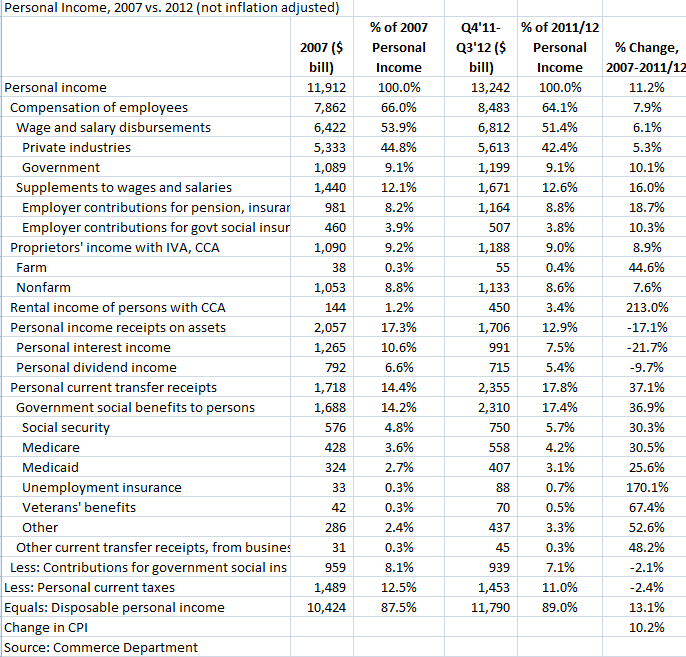
Where We Get Our Money – Personal Income, 2007 vs. 2012

The personal income data in the GDP accounts provides good insights into structural changes in the U.S. economy.  We compare the most recent figures (four quarters ending Q3 2012) with 2007. These are nominal data, i.e., not adjusted for inflation.  Key trends:

  • Personal income is barely beating inflation.  Since 2007 it rose 11.2% vs. a 10.2% rise in the CPI.  This partly reflects Washington’s war on employment, as well as fairly strong commodity prices.
  • Because taxes are down slightly, Disposable Personal Income is a little stronger, up 13.1%.  So disposable income is up about 3% after inflation.  However, U.S. population rose about 4.3% over this period, so real personal disposable income per capita declined slightly, 2007-2012.  We are getting poorer, but the media still does not think we pay enough taxes.
  •  Spendable income is even weaker; “wages and salaries” – the compensation you can waste at the mall – grew just 7.9%, although admittedly it was supplemented by certain transfer payments, which are booming (see below).  The other component of compensation, “supplements to wages and salaries” (i.e., corporate benefits such as pensions and health insurance) grew much faster, 16.0%.  This is bullish for healthcare stocks, if you can find one not squeezed by government policies.  Obamacare accelerates this rapid growth in non-spendable income by mandating a costly basic health insurance package.
  • Government is growing twice as fast as the private sector.  Private wages and salaries grew 5.3%, vs. 10.1% for government wages and salaries.  Don’t believe those who complain the only reason employment is weak is that conservatives are starving government; private employment collapsed early in the recession while government employment was still growing.  (See my June 29 post.)
  • Farm income is booming, up 44.6% vs. just 7.6% for nonfarm.  Bullish for ag stocks like Deere, whose earnings have held up quite well; its little-noticed construction equipment business (17% of revenue) is benefiting from an upturn in building activity.  Buffett recently bought the name.  I own a little.
  • Government transfer payments are through the roof, up 37%.  The terrible troika – Social Security, Medicare, Medicaid – are all up 30-37%, but unemployment insurance is up a huge 170%.

All in all, not a pretty picture, and set to get worse as taxes rise and transfer payments are pared back.  Next year uninsured individuals have to pay the Obamacare tax, cutting spendable income even more.  Euro-sclerosis, here we come.  Real personal disposable income per capita is declining, even though government transfer payments are soaring.  Wages and salaries are much weaker than overall personal income, and the wages and salaries of workers in the private sector dramatically lag the public sector.  Among the few “sweet spots” in the U.S. economy are writing regulations in Washington DC and growing corn and soybeans in Iowa.

personal income


Copyright 2012 Thomas Doerflinger.  All Rights Reserved.


Posted in Uncategorized | Leave a comment

Follow-up: Regulators Gone Wild – the “Cumulative Effect”

Our July 9 screed on the “other Keynesian paradigm” argued that over-regulation was killing what Keynes called “animal spirits” in the private economy.  We quoted Jamie Dimon’s peroration to Ben Bernanke where Jamie ticked off a gigantic (but still incomplete) list of regulations and reforms raining down on financial firms from all directions.  It concluded with this fascinating exchange (emphases mine):

Dimon:  “Has anyone bothered to study the cumulative effect of all these things?  And do you have a fear like I do that when we will look back and look at them all, they will be the reason it took so long for our banks, our credit, and our businesses – and most importantly, job creation to start going again. Is this holding us back at this point?”

Bernanke:  “Has anybody done a comprehensive analysis of the impact on credit? I can’t pretend that anybody really has. You know, it’s just too complicated. We don’t really have the quantitative tools to do that.”

Well, now someone has indeed done a “comprehensive analysis of the impact on credit.”  Allen & Overy, a giant international law firm based in London, did an exhaustive analysis of financial regulation in major economies around the world.  It concluded that “The regulatory approach governing the financial system lacks coherent design and is disabling the flow of credit necessary to fuel economic growth.” In an interview with Bloomberg Mr. Etay Katz, the partner in charge of the study, rather precisely echoed Dimon:

“We basically are calling for action.  Four years down the line after the crisis, we are seeing huge amounts of regulation, thousands and thousands of pages impacting banks in particular but not only banks.  What we are failing to see is people stepping back and looking at the cumulative effect of all of this. . . There is a lack of intelligent design in global regulation…….we see a lot of turf wars and incohesion and duplication and uncertainty.… We are seeing a lot of disabling and over-ratcheting up of regulation but not an intelligent design and seeing what the real economy needs at this point in time…..Regulators are entrusted with stability, and they are taking that responsibility to an extreme.” (emphasis mine)

So the good news is that we won’t have another financial crisis for a while and there are plenty of high-paid jobs for lawyers and regulators in Washington, London, and Basel.  The bad news is that, because no one is monitoring the “cumulative effect” of the regulatory avalanche, credit flows are weak, global GDP growth is anemic, unemployment remains high, and living standards are declining for the hallowed “middle class” whom regulators claim to be protecting. This problem will get worse because less than half of the regulations in the Dodd Frank bill have actually been spelled out, according to Washington law firm Arnold & Porter.  The winners among banks are the too-big-to-fail giants who can afford to hire platoons of lawyers.  The losers tend to be “community banks” that lend to small businesses on more of a person-to-person basis.  Oops, sorry about that, middle class.

On Wall Street and off, conventional macro economists largely ignore this problem of over-regulation, because, as their fearless leader Ben Bernanke (formerly chairman of the Princeton Economics Department) noted, it cannot be quantified.  In Econoland, if it cannot be quantified it does not exist.

Copyright Thomas Doerflinger 2012.  All Rights Reserved.

Posted in Uncategorized | Tagged , , | Leave a comment

Over the Cliff We Go

I would hold off buying stocks here.  Earnings momentum is poor, much of the world is in or near recession, stocks are not particularly cheap at 13.4x 2013E EPS of $106, and the probability we go over the fiscal cliff on January 2 is high—over 75%, in my opinion.  Why am I bearish on the Fiscal Cliff?  Right after the election, John Boehner offered a significant concession – raising taxes on the rich by cutting loopholes.  The White House came back with a complex proposal, really a Democratic wish list, that Republicans considered “unserious” if not insulting. When he heard it, Mitch McConnell burst out laughing.  Meanwhile, just three weeks after the election, Obama is back on the campaign trail, agitating for higher tax rates on the rich.  Not an auspicious way to start productive negotiations.

An optimist would say Obama’s opening bid is just posturing aimed at impressing his base, prior to concessions he will have to make later.  If so, he was successful. NPR reporters were positively giddy when describing his derisive offer; CNBC likened it to the Godfather scene where Michael Corleone offers “nothing” to a corrupt Nevada Senator who demands a bribe to grant a gaming license. But this opening gambit, the optimistic scenario goes, will soon be followed by serious negotiation to avoid the cliff.  Larry Kudlow reasons it would be terrible for Obama’s legacy if, following a pathetically weak economic recovery in his first term, his second term starts with a recession.  He’d make Herbert Hoover look good.  Some pundits say “the blame” would be heaped on the Republicans, not Obama.  To which Kudlow correctly counters, “No one knows who was the Speaker of the House when Herbert Hoover was in the White House.  The President gets the blame.”

While it is impossible to disprove this optimistic scenario, there are good reasons to be skeptical.  Following the bitter 2011 negotiation—when Obama became enraged when Boehner broke off talks—there is already plenty of “bad blood” between the two, and now Round II has started off on the wrong foot.  Obama has always wanted to be a “transformational” President willing to take chances with the economy; in 2009 he focused on healthcare reform rather economic recovery.  Income redistribution is his top priority, and in his mind that means higher tax rates; liberal Democrats blame the infamous “Bush tax cuts for the rich” for all that has gone wrong with the economy over the past decade. (Weird but true.)  And Obama considers himself to be in a very strong position, because if we do go over the cliff taxes rise on everyone; he can blame Congressional Republicans for that and then negotiate a tax reduction for the “middle class” while leaving most of the defense cuts in place.

Another reason for caution is that the issues in play are numerous and complex—tax rates on ordinary income, potential cuts in tax deductions, tax treatment of dividends and capital gains, whether to extend the payroll tax cut, cuts in discretionary spending, the Alternative Minimum Tax, and reforms of Medicare and Social Security. And don’t forget the need to raise the debt ceiling.  Republicans sound serious that they refuse to yet again “kick the can down the road” on entitlement reform, but liberal Democrats oppose changes to Medicare and Social Security (apparently even changes that mainly hit “the rich”).

Furthermore, we are hearing that the “cliff” is actually more of a “staircase.”  Unlike 1995 there will be no dramatic government shutdown, just a supposedly temporary rise in tax rates and a slow-walk by bureaucrats in Washington DC to reduce spending.  (The Pentagon has yet to make contingency plans for going over the cliff.)  So the sense of urgency is greater on Wall Street than in Washington which, after all, never saw a tax increase it did not like.  But the Alternative Minimum Tax raises the stakes.  Mellon Bank’s Dick Hoey reckons that if the AMT is not fixed 28 million middle-class taxpayers will be hit with the AMT and, in many cases, not receive the tax refund they were counting on.

Which takes us back to the stock market.  If I am wrong and we do get a deal before year-end, one inducements is likely to be a stock market plunge in the U.S. and perhaps overseas.  So, whether we do or don’t get a deal by year-end, the upcoming fiscal cliff fisticuffs are likely to create a buying opportunity over the next couple of months.

Posted in Uncategorized | Tagged , , | Leave a comment

The Other Euro Crisis – U.S. Markets Trump European “Science”

A smart sociologist once noted that every nation has a metaphorical mass movement that captures its mentalite — for Americans, it is the trek into the frontier; for the French, storming the Bastille; for Chinese Communists, the Long March; for the Jews, wandering in the desert.

And for the European Union? – A few dozen well-dressed politicians and technocrats, huddled in a conference room drafting rules, regulations, and “directives” for their fellow citizens.  It is a non-stop process.  Long-time readers of The Financial Times know there is always at least one urgent negotiation under way in Brussels — crafting the Maastricht Treaty, drafting the EU Constitution, deciding whether to admit new members, launching the Euro, or formulating the “20/20/20 directive” to address climate change.  In the words of Bjorn Lomborg, 20/20/20 “aims to cut greenhouse gas emissions to 20 per cent below 1990 levels by 2020 (and ensure 20 per cent renewable energy).”

And now Eurocrats have spent three years arguing about how to contain the Euro-crisis they set in train by creating a single currency for 17 economies that have separate and distinctive labor markets, fiscal policies, and banking systems.  This colossal blunder has obscured the costly failure of Europe’s climate change policy, which was nicely delineated by Dieter Helm in a recent New York Times article.  Unlike your scribe, Mr. Helm, a professor of energy policy at Oxford University, is not a benighted climate change skeptic; on the contrary, he fervently believes in “putting a price on carbon” to save the planet.

So why does Mr. Helm believe Europe’s carbon policy has failed?  For reasons that, frankly, could have been foreseen years ago.  Europe has invested heavily in expensive “renewable” power such as wind and solar, but this has had a negligible impact on global greenhouse gas emissions because A) the high cost of energy has chased energy-intensive industries to China and other coal-based economies,  B) any small emission reduction achieved in Europe has been overwhelmed by massive emission increases in China.  Europe fancied itself a “leader” on global climate change, but no one followed.  European pain has produced trivial global gain.  The resulting “lack of competitiveness” has exacerbated the Euro-crisis we read about every day.  (California is in the process of making the same mistakes.)

But it gets worse for Europe’s greenies.  While they were “doing the right thing” to lead on global climate change and failing miserably, across the pond in the U.S. greedy capitalists who refused to ratify the Kyoto Treaty were doing something that actually managed to both A) reduce carbon emissions and B) strengthen the U.S. economy and raise living standards.  Using fracking technology, U.S. energy companies produced vast quantities of natural gas, which is much “cleaner” than coal (if you consider CO2 a pollutant).  In the U.S., Mr. Helm notes, emissions “are falling faster than Europe’s.”  No thanks to America’s enviro-gentry.  Tom Friedman’s 2008 book on energy policy, Hot, Flat, and Crowded, does not even mention fracking.

Europe’s misadventures in both economic policy and “climate science” illustrate the stark limitations of top-down planning by elites, be they in Brussels, Washington, Moscow or Beijing.  Self-admiring progressives like Paul Krugman love to contrast their brainy, empirical, coolly analytical approach to policy issues with that of Republicans who are “fundamentally hostile to the very idea of objective inquiry.”  But it was Democrats who wanted to follow Europe’s disastrous energy policy.  What is more “irrational” —  believing the world was created in seven days, or believing that China, which is building a new coal-fired power plant every week, would “follow our lead” if the U.S. foolishly spent trillions on renewable energy?  The Chinese are not that dumb; they know wind and solar cannot come close to meeting the energy needs of an advanced industrial economy.  Come to think of it, so does Uncle Sam; the EIA forecasts that in 2035 only around 5% of U.S. electricity will be generated from wind and solar.*


*Energy Information Agency, Annual Energy Outlook 2012 (June 2012), Table 25.   The EIA estimates total electricity generation plus imports of 5004 billion kilowatt hours, of which 780 or 15.6% are “hydroelectric/other.”  The 5% figure assumes that a third of this 780 is wind and solar, which may be generous given that the category is broad and includes “conventional hydroelectric, pumped storage, geothermal, wood, wood waste, municipal waste, other biomass, solar and wind power, batteries, chemicals, hydrogen, pitch, purchased steam, sulfur, petroleum coke, and miscellaneous technologies.”  These sources seem to be listed in order of importance, and “solar and wind” only rank eighth.

Copyright Thomas Doerflinger.  All Rights Reserved.

Posted in Uncategorized | Tagged , , | Leave a comment

What the Big Money Owns

The folks who run America’s biggest equity mutual funds are very smart (most of the time) and very well informed. They get the “first call” from Wall Street analysts, and speak to top corporate executives regularly.  For example, no corporate management does a road show in Boston without stopping at Fidelity’s offices to tell their story.  So we scanned the Websites of Fidelity, Vanguard and T. Rowe Price to find out what 16 of their actively managed domestic equity mutual funds owned.  They are all large, large-cap, growth oriented funds.  Only the top 10 stock holdings of each fund are disclosed, and not necessarily in order of their importance.  So we can learn how many funds, for example, have ExxonMobil among their top 10 holdings.  This is a decent indicator of stocks’ popularity with big,  growth-oriented mutual funds.

Whether it is “bullish” or “bearish” for a stock to be heavily owned by these funds is a matter of debate.  The bull case is that smart, well-informed portfolio managers like them now.  The bear case is that they “already own” them, and their next likely move will be to sell  them—but maybe not for a long time.

The two most popular stocks are AAPL with 12 places (no surprise) and GOOG with 9 (a bit of a surprise, because management is rather unpopular with investors, and allegedly unfocused).

QCOM is fairly popular with 4 places; it is the best semiconductor play on smartphones and far more popular than INTC (0 places), which so far has missed the mobile boat.

EBAY is also fairly popular with 4 places; PCLN has just 1.

Interestingly, MSFT is still fairly popular with 4 places—versus just 1 for IBM.  To hear some of the TV pundits talk, one would think MSFT is just a step behind RIMM on the road to oblivion.  But the Big Money is betting that, despite the alleged demise of the PC, MSFT’s very strong franchise in global corporations (not just PC operating systems and applications, but also servers) will continue to generate strong cash flow.  Balmer’s company always seems to be a day late and a gigabyte short, but in fact it has done well in game consoles, and the Surface has received some good reviews.

XOM is by far the most popular energy stock (8 places), which is surprising because its reserve growth is weak, and it overpaid for natural gas play XTO.

The most popular retailers are HD (4 places), WMT (4) and – far more interestingly — TJX (3).

For contrarians, the most salient fact is that most large industrials and materials such as CAT, DE, UTX, DD, and DOW are not represented.   The exceptions are GE (4 places), DHR (2 places) and BA (1).

The most popular healthcare names are JNJ and PFE, both with 4 places.

The Big Money likes the global credit card networks, MA (3 places) and V (4 places).  Evidently PM’s are not worried about disintermediation from new technology.

In finance the Big Money is betting on two names that have become “consensus longs” — USB (4 places) and WFC (5).  These “high quality” companies came out of the crisis relatively unscathed but, in the case of WFC, much bigger.   Compared to Wall Street firms they have limited regulatory risk, and some major competitors (such as C, BAC, and European banks) are pulling back from key markets.  Incredibly, BAC bought Countrywide to become a giant in mortgages but now is a bit player; meanwhile, WFC has grabbed a 33% share.  JPM has just 2 places on the Big Money list.

Copyright Thomas Doerflinger 2012.  All Rights Reserved.

Posted in Uncategorized | Tagged , , | Leave a comment

The Culture of Capitalism and BRIC Investing

Important insights for investors are to be found in historian Joyce Appleby’s thoughtful and informative book The Relentless Revolution: A History of Capitalism.  She agrees with Max Weber’s observation that “A man does not by nature wish to earn more and more money, but simply to live as he is accustomed to live and to earn as much as is necessary for that purpose.”  Which is what people in traditional societies have done for millennia.  They rely on tried and true methods of production, but are fated to endure periodic famines and plagues.

Appleby sets out to explain why this old order gave way to modern capitalism, which she defines as “a system of individual investments in the production of marketable goods,” animated by the “imperative of private investors to turn a profit.”  Her key premise is that the development of capitalism was not a natural or inevitable process but rather was the result of factors and forces that came together at a specific time and place – England in the 17th and 18th centuries.  They included:

  • The protestant reformation of the 16th century.  As Max Weber argued, Protestants viewed worldly success as evidence of salvation and therefore pursued it with dogged, systematic determination. Prominent English industrialists tended to be Protestants, frequently Quakers.  In France, protestant Huegenots were typically more capitalistic than Catholics. (Interestingly, these same modern-minded groups led the drive to abolish slavery.)
  • The gradual modernization of agriculture in the Netherlands and later England created food surpluses, which freed up labor for non-agricultural activities while creating stronger demand for manufactures.  In contrast to France, England did not suffer a serious famine after the mid-17th century, though chronic hunger continued to torment the poor.
  • The colonization of the New World by Europeans had two important effects.  Big profits in both Britain’s horrific slave trade (centered in Liverpool and London) and Caribbean sugar production generated ample risk capital.  Meanwhile, by the eighteenth century North America was a large, affluent, fast-growing market for English manufactures; this fostered the “division of labor” heralded by Adam Smith in The Wealth of Nations.  Particularly after 1740 or so, enormous shipments of “dry goods” were shipped in the spring and autumn from London, Bristol and later Liverpool to merchants in Philadelphia, New York, and other ports; they in turn sold them to retailers and artisans throughout North America.  Note that booming colonial markets supported an impressive expansion of British manufacturing before it was mechanized during the “industrial revolution.”
  • As an island nation with a single giant capital city, Britain was a more accessible and integrated market than other large countries in Europe.  Most parts of England had fairly good access to the ocean, and many aristocrats spent part of the year in London–the seat of government, commerce, and finance.
  • Scientific advances during the 18th century enlightenment were instrumental in certain technological breakthroughs, such as the steam engine.

Other places —  13th century Venice, 15th century Florence, 17th century Holland– shared some of these characteristics and became thriving centers of finance and commerce.  But they never developed the transformative “culture of capitalism” that turned England, Germany and the U.S. into industrial giants over the course of the 19th century.

Why Should Investors Care?

For one thing, the notion that capitalism is a historically contingent cultural construct is subversive of conventional economic analysis, which naively assumes that people are naturally profit maximizers.  In the real world, some people are, others aren’t.  Nations that place a lower priority on rapid economic growth, with its attendant unpleasant side effects such as social turbulence and high income inequality, will grow more slowly.  Look at Western Europe:  Yes, the single currency was a very dumb and destructive idea, but Europe’s economic growth problems go well beyond that to a visceral aversion to capitalism.  In the U.S., Texas creates more jobs than other large states not primarily because of oil and gas (which California and New York also have) but rather because it has a far more laissez faire political economy.

All this has special relevance to investors in emerging markets.  I claim no expertise here, but it is obvious that, to varying degrees in each of the BRIC countries (Brazil, Russia, India, China), the “culture of capitalism” must contend with potent countervailing traditions, institutions, and cultural impulses — government corruption, uncertain  property rights, excessive regulation, autocratic leaders, etc.  All of which make investing in emerging markets rather risky.  One reason why I like U.S. multinationals is that they participate in the growth of a diverse array of emerging markets, but without the risks attendant to actually being headquartered there.

Not that the U.S. is immune from anti-capitalistic impulses.  The very affluence of the U.S. has given rise to powerful interest groups in government, universities, foundations, etc. that are insulated from market forces and committed to aggressive intervention in the private economy.  As we saw in the 1970s and are seeing today, such “reforms,” however well-intentioned they may be, can impede growth, reduce living standards, and increase poverty.

Copyright Thomas Doerflinger 2012.  All Rights Reserved.

Posted in Uncategorized | Tagged , , | Leave a comment

Why You Need an Investment Advisor, Part II — The “Unthinkable” is Normal

Why is it so difficult to stay fully invested in stocks in a disciplined, rational manner, without participating in manias or selling at the bottom?  Because, even during bull markets, lengthy periods of stable, normal economic growth are actually extremely rare.   “Unthinkable” events occur on a regular basis.  Consider stock market history over the past four decades:

  • 1973:  Commodity prices soar and oil prices quadruple as OPEC embargoes oil during the Yom Kippur War.  Prices of the high-PE “nifty fifty” growth stocks collapse.
  • 1980:   CPI inflation is 13.5% and interest rate soar to 20%.  Economists believe inflation will remain elevated for years.  Boom times in Texas.
  • 1983:  Instead inflation falls to 4% by 1983. With commodity prices and corporate pricing power collapsing, the profitability of many big U.S. industrial firms implodes.  Mexico and other “LDC’s” effectively go bankrupt, threatening New York Banks.  By 1990 all the major banks in Texas disappear.
  • 1987:  Stock prices fall 22% in a day and more than 30% over just two months.
  • 1990:  The real estate and LBO boom of the 1980s ends as Saddam Hussein invades Kuwait in the summer 1990. The ensuing recession nearly precipitates a financial crisis.
  • 1998:  The  Asian financial crisis causes a global financial panic that destroys one of the biggest hedge funds, Long Term Capital Management. Stocks plunge and the junk bond market temporarily seizes up.
  • 2000:  A five-year stock market boom culminates in a tech bubble that collapses in 2000-2001; stocks don’t bottom out until October 2002.  (The tech crash was even more costly than the 1929 crash because many dot.com’s and other widely held issues effectively went to zero, including Enron, Worldcomm, Lucent, Nortel and Sun Microsystems.  The most popular stocks in the 1920s, such as RCA, GM, Chrysler, GE, and Allied Chemical, lived to fight another day.)
  • 2001:  Al Qaeda destroys the World Trade Center and attacks the Pentagon, starting a protracted global “War on Terror.”
  • 2008:  A housing bubble, promoted by Democrats and Republicans alike, leads to a financial crisis that nearly destroys the global banking system in 2008-2009.
  • 2009:  Europe’s financial system is crippled by a protracted crisis caused by European socialism (too much government, not enough growth), a recession that shatters housing bubbles in certain countries, and a dysfunctional currency system.

That is ten crises in forty years, or one every four years. No wonder it’s hard to hang on to stocks.  But good businesses managed to prosper nonetheless; the S&P 500 rose at a 6.3% pace from year-end 1972 to year-end 2011, the average dividend yield was 3.0%. Here are the 40-year stock price CAGRs of a few successful companies:  McDonald’s 10.0%, Caterpillar 7.2%, Wal-Mart 20.2%, Coca-Cola 8.4%, GE 7.1%, 3M 5.5%.  The 20-year stock price CAGR was 20.5% for Starbucks, 9.5% for Intel, 12.2% for Microsoft, and 11.9% for Nike.  The total returns of these stocks were even higher, taking dividends into account.  Of course, not all companies are as successful as these, which is why you should keep your winners and sell your losers.

The “Unthinkable is Normal” syndrome underscores why equity investors need a safe cash cushion, for both practical and psychological reasons.   In a perceptive article on the history of stock market returns, Ben Inker of GMO points out that one reason why stocks offer investors an attractive 5.9% real long-term return is that stocks tend to collapse at the most inopportune times – during panics, wars, and recessions, when investors most need the money. Which is why buying stocks on margin is dangerous and unwise.

Copyright Thomas Doerflinger 2012.  All Rights Reserved.


Posted in Uncategorized | Tagged , , , | Leave a comment